
- Published on
Why Your CGM Estimated A1C Doesn't Match Lab Results
You have been wearing your continuous glucose monitor (CGM) faithfully, checking your daily trends, and celebrating your steady glucose curves. Your CGM app shows an estimated A1C (average blood sugar level over 3 months) of 6.2%. But when your lab blood test results come back, the number on the paper is 6.8%.
If this has happened to you, you are not alone. It is incredibly common to see a mismatch between your CGM's estimated A1C and your actual laboratory results. This discrepancy can be confusing, frustrating, and even discouraging when you have been working hard to manage your health.
Understanding why these two numbers differ is key to removing the anxiety from your health journey. Let's explore the biological and technological reasons behind this gap, and learn how you can use both metrics to gain a complete picture of your metabolic health.
Understanding the Two Metrics: HbA1C vs. GMI
To understand why these numbers do not always align, we first need to look at how they are measured. Although they both aim to represent your average blood sugar, they use entirely different methods and biological markers to get there.
Laboratory HbA1C measures the percentage of your hemoglobin—a protein in your red blood cells—that has glucose attached to it. Because red blood cells live for about 120 days, this test provides a biological average of your blood sugar over the past 2 to 3 months.
On the other hand, your CGM does not measure blood or hemoglobin at all. Instead, it measures glucose in the interstitial fluid (the fluid between your cells) every few minutes. Your CGM app takes these thousands of daily readings over a set period—usually 14 to 90 days—and applies a mathematical formula to calculate an estimate.
To prevent confusion, clinical organizations officially changed the name of this CGM estimate from "estimated A1C" (eA1C) to GMI, which stands for Glucose Management Indicator. GMI is an estimate of what your A1C is likely to be, based on your average sensor glucose.
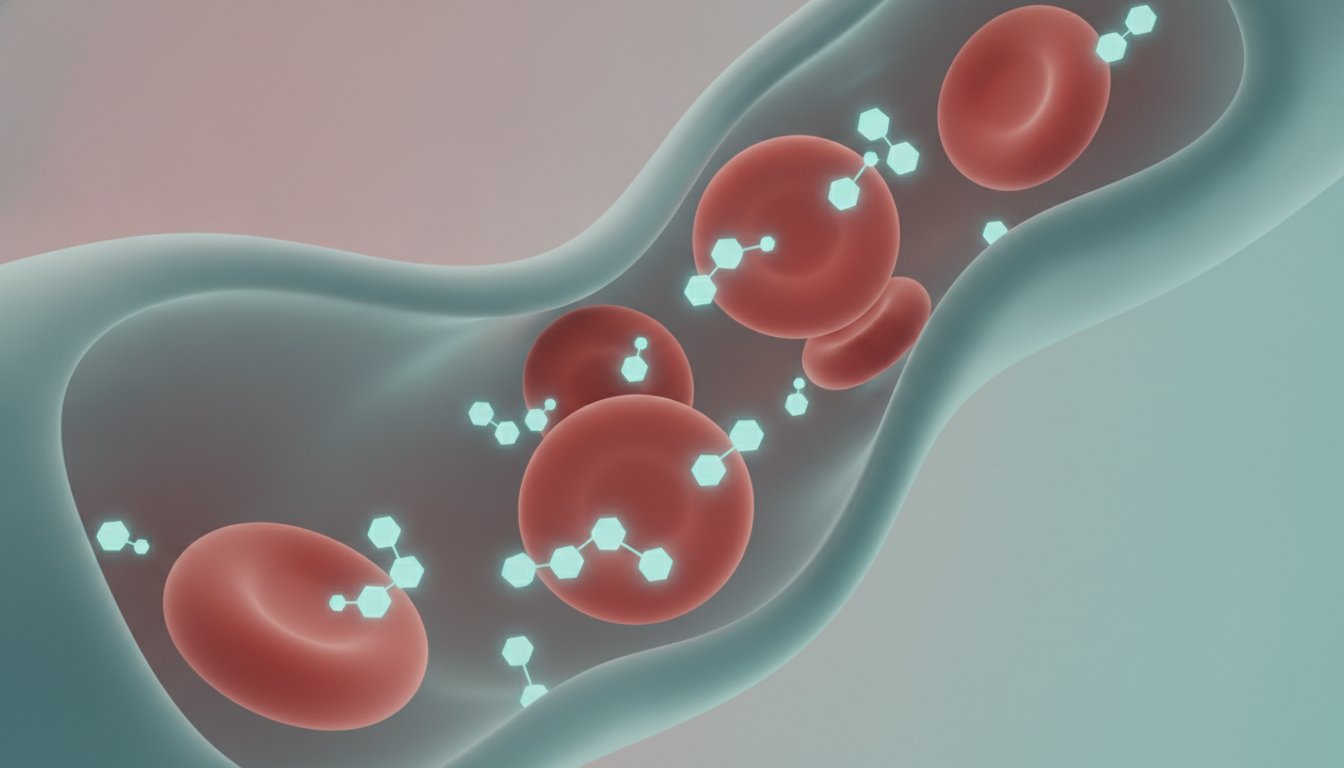
Why Your Lab A1C and CGM GMI Don't Match
Several biological, mechanical, and mathematical factors can cause a gap between your lab A1C and your CGM's GMI.
1. Red Blood Cell Lifespan Variations
The laboratory A1C test relies on a standard assumption: that everyone's red blood cells live for exactly 120 days. However, human biology is rarely that uniform.
If your red blood cells live longer than average, they have more time to accumulate glucose, which can artificially raise your lab A1C. Conversely, if your red blood cells turn over quickly, your lab A1C may appear lower than your actual average blood sugar. Factors that alter red blood cell lifespan include:
- Anemia or iron deficiency
- Pregnancy
- Recent blood loss or blood donations
- Certain vitamins, such as B12 or folate deficiencies
- Kidney or liver disease
Because your CGM measures glucose directly from interstitial fluid, it is completely unaffected by your red blood cell lifespan.
2. Blood Glucose vs. Interstitial Fluid
Your CGM sensor sits just under your skin, measuring interstitial fluid glucose. While interstitial glucose highly correlates with blood glucose, there is a natural lag time of about 5 to 15 minutes.
During times of rapid glucose changes—such as right after a high-carb meal or during intense exercise—the difference between blood glucose and interstitial glucose is most pronounced. These daily microscopic differences can accumulate over weeks, leading to variations in the final calculated averages.
3. Different Timeframes and Data Gaps
A laboratory A1C is heavily weighted toward your blood sugar levels over the most recent 30 days, though it captures a 90-day window.
Your CGM GMI, however, is a simple mathematical average of the active sensor data you have collected. If you had a few days where you did not wear your sensor, or if you only look at a 14-day GMI window, your CGM is missing a significant portion of the 90-day window that your lab test covers.
4. Individual Glycation Rates
Glycation is the process by which glucose bonds to proteins like hemoglobin. Some people are naturally "fast glycators," meaning glucose binds to their red blood cells more quickly than average. Others are "slow glycators."
If you are a fast glycator, your lab A1C will consistently run higher than your CGM GMI, even if your average glucose readings are perfectly stable. The mathematical formula used to calculate GMI is based on population averages and cannot account for your unique glycation rate.
Why the FDA Switched to the Term "GMI"
Because patients and doctors frequently experienced confusion over why "estimated A1C" did not match lab results, the US Food and Drug Administration (FDA), along with leading diabetes organizations, introduced the term Glucose Management Indicator (GMI) in 2018.
The name change was deliberate. Calling the CGM metric "estimated A1C" made it sound like a direct replacement for the laboratory test. By renaming it to GMI, clinicians wanted to emphasize that it is a separate, highly valuable clinical tool in its own right.
Think of GMI as a real-time management tool that reflects your current glucose patterns, while lab A1C is a historical, biological report card.

How to Use Both Metrics Together for Better Health
Instead of viewing the discrepancy between your GMI and lab A1C as an error, you can view them as complementary tools. Together, they provide a much richer picture of your metabolic health than either could alone.
Here is how you can use both metrics effectively:
- Focus on the trend, not just the absolute number: If your lab A1C is 6.8% and your GMI is 6.2%, look at how they move over time. If your GMI drops to 5.8% by your next checkup, your lab A1C will likely show a corresponding drop, even if the numbers do not match exactly.
- Prioritize Time in Range (TIR): Lab A1C cannot show you daily fluctuations. A person with wild blood sugar spikes and frequent dangerous lows can have the exact same lab A1C as someone with perfectly stable, flat glucose curves. Your CGM data provides your Time in Range (the percentage of time your glucose stays between 70 and 180 mg/dL), which is often a better indicator of daily well-being and energy levels.
- Keep your sensor active: To get the most accurate GMI that closely mirrors your lab results, aim to wear your CGM at least 70% to 80% of the time over a 90-day period.
- Consult your healthcare provider: Always discuss your results with your doctor. If there is a massive discrepancy (more than 1% difference) between your GMI and lab A1C, your doctor can investigate underlying biological factors, such as iron levels or red blood cell health, to ensure your treatment plan is accurate and safe.
Key Takeaways
- Different measurement methods: Lab A1C measures glucose attached to red blood cells over 90 days, while CGM GMI calculates an average from interstitial fluid.
- Biological differences: Variations in red blood cell lifespan, iron levels, and individual glycation rates can cause lab A1C to run higher or lower than your CGM GMI.
- GMI is a guide, not a lab test: The term GMI was created specifically to help users understand that CGM estimates are clinical management indicators, not direct replicas of lab results.
- Both metrics matter: Use GMI and Time in Range to manage your daily habits, and use lab A1C as a standardized biological benchmark.
Empower Your Health Journey
Understanding your glucose data does not have to be a guessing game. While your lab results give you a vital clinical checkpoint, tracking your daily trends is what empowers you to make sustainable lifestyle choices.
Using glucose tracking apps can help you bridge the gap between your daily CGM readings and your clinical health goals. By logging your meals, physical activity, and daily trends in one place, you can easily visualize how your lifestyle directly impacts your glucose curves.
Ready to take control of your metabolic health with clear, actionable insights? Download GlucoAI today to start logging your trends, optimizing your Time in Range, and preparing for your next doctor's visit with confidence.
GlucoAI — Smart Blood Sugar Monitor
Track, analyze, and optimize your glucose levels with AI-powered insights.