
- Published on
Glucose Monitoring for Longevity: A Beginner's Guide
What if you could see inside your body and watch how every bite of food, every stressful meeting, and every workout changed your biology in real-time? For a long time, we viewed blood sugar monitoring as something reserved only for people living with diabetes. However, a new wave of health science suggests that monitoring your glucose is one of the most powerful tools available for anyone interested in longevity and metabolic health optimization.
Longevity isn't just about reaching a certain age; it is about extending your "healthspan"—the number of years you live in vibrant, functional health. At the heart of a long and healthy life lies metabolic health. When your metabolism is functioning optimally, your body processes energy efficiently, your inflammation levels stay low, and your risk for chronic diseases plummets. Glucose monitoring provides the data you need to steer your metabolic ship in the right direction.
What Is Glucose Monitoring for Longevity?
To understand glucose monitoring, we first need to understand glucose itself. Glucose is the primary sugar found in your blood and the main source of energy for your body's cells. It comes from the carbohydrates you eat. When you consume carbs, your body breaks them down into glucose, which enters your bloodstream. In response, your pancreas releases insulin, a hormone that acts like a key, letting the glucose into your cells to be used for energy.
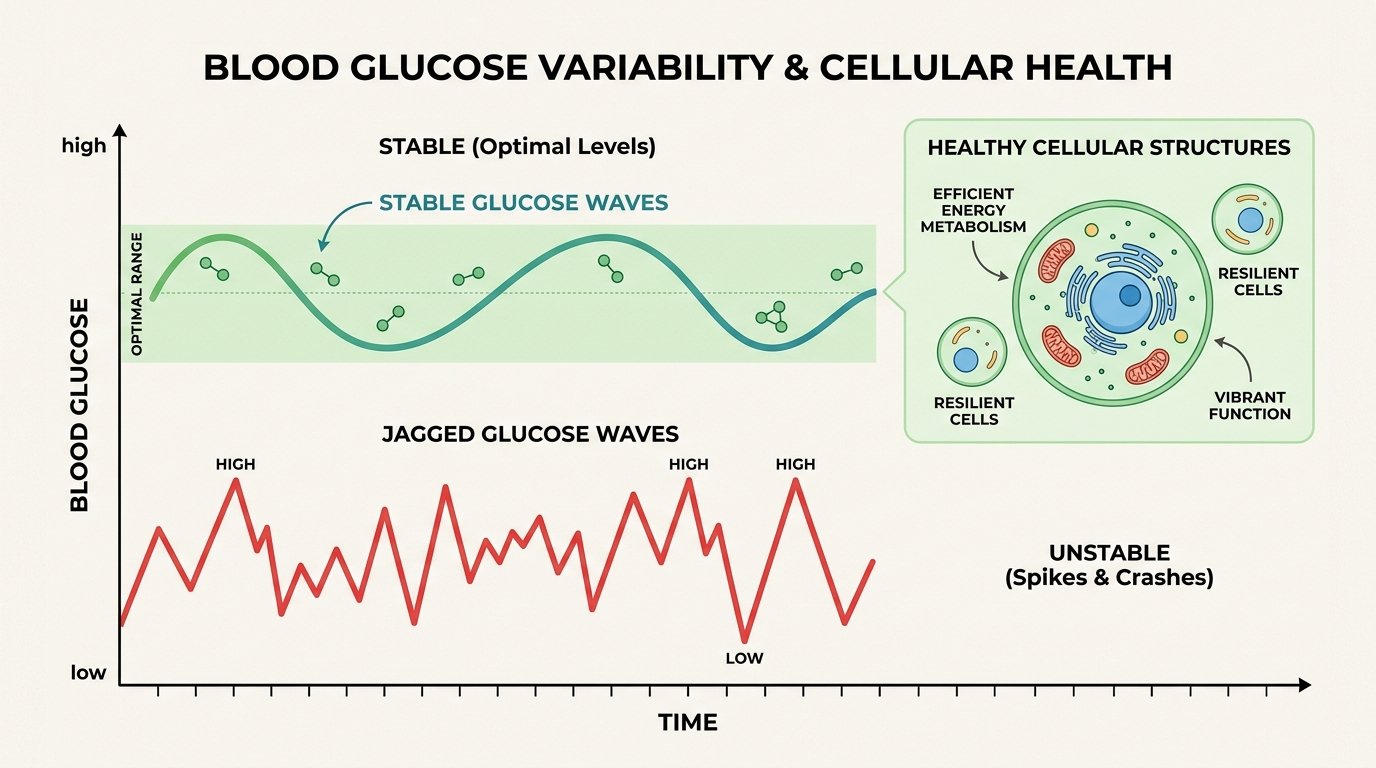
For most people, this process happens behind the scenes. However, many of us experience "glucose spikes"—sharp rises and falls in blood sugar—multiple times a day without even knowing it. Over time, these spikes can lead to insulin resistance, where your cells stop responding effectively to insulin. This is a primary driver of aging and chronic disease.
Glucose monitoring for longevity involves using tools to track these fluctuations. By understanding your "glucose curves," you can make lifestyle adjustments that keep your blood sugar stable. The goal isn't just to stay within a "normal" range, but to achieve an "optimal" range that minimizes biological wear and tear.
Why Does Glucose Stability Matter for Aging?
You might wonder why a spike in blood sugar matters if it eventually comes back down. The reality is that frequent, high-magnitude glucose spikes accelerate the aging process through several key mechanisms:
1. Glycation and AGEs
When glucose levels are high, sugar molecules can attach to proteins and fats in your body in a process called glycation. This creates harmful compounds known as Advanced Glycation End-products (AGEs). Think of AGEs as "cellular rust." They damage collagen (leading to wrinkles), stiffen arteries, and can even impair brain function. By keeping glucose stable, you reduce the production of these aging accelerators.
2. Oxidative Stress and Inflammation
Every time your blood sugar spikes, your mitochondria (the powerhouses of your cells) have to work overtime to process the excess energy. This creates "exhaust" in the form of free radicals, leading to oxidative stress. Chronic oxidative stress triggers systemic inflammation, which is the root cause of almost every age-related condition, from heart disease to Alzheimer’s.
3. Insulin Sensitivity
Keeping your glucose levels stable means your body needs less insulin to manage the load. Lower average insulin levels are strongly associated with increased longevity. When insulin is constantly high, it signals the body to store fat and inhibits "autophagy"—the body's natural cellular cleaning process that removes damaged components.
How to Monitor Your Glucose: The Tools of the Trade
If you are ready to start your journey toward metabolic optimization, you have two primary options for monitoring your levels.
Blood Glucose Meters (BGM)
This is the traditional "fingerstick" method. You prick your finger with a small lancet and place a drop of blood on a testing strip.
- Pros: Highly accurate, affordable, and requires no prescription.
- Cons: Only provides a "snapshot" in time. You might miss a spike that happens 45 minutes after you test.
Continuous Glucose Monitors (CGM)
A CGM is a small sensor worn on the back of the arm or the abdomen. It measures glucose in the interstitial fluid (the fluid surrounding your cells) 24 hours a day.
- Pros: Provides a complete picture of your glucose trends, including what happens while you sleep. It shows you exactly how high you spike and how long it takes to come back down.
- Cons: More expensive and often requires a prescription or a specialized service.
For beginners, starting with a fingerstick meter can be a great way to learn the basics, but a CGM is the "gold standard" for those serious about longevity because it reveals the hidden patterns that a single test would miss.
A Beginner’s Roadmap to Optimization
Monitoring your glucose is only half the battle; the real magic happens when you use that data to change your habits. Here is a three-step plan to get started:
Step 1: Establish Your Baseline
Spend the first week just observing. Don't change your diet yet. Track what you eat and see how your body responds. Note your "fasting glucose" (your level when you wake up) and your "post-meal spikes." An optimal fasting glucose for longevity is generally considered to be between 70 and 90 mg/dL, though you should always consult your doctor about your personal targets.
Step 2: Identify Your "Trigger Foods"
Everyone’s biology is unique. One person might see a massive spike from oatmeal, while another stays stable. Use your monitoring tool to identify which foods send your blood sugar into the stratosphere. Common culprits include white bread, sugary cereals, and tropical fruits, but you might be surprised by what you find.
Step 3: Implement "Glucose Hacks"
Once you know your triggers, you don't necessarily have to give them up forever. You can "buffer" the glucose response by:
- Changing the food order: Eat fiber (veggies) first, then protein and fats, and save carbohydrates for the end of the meal.
- Adding a "glucose vest": Adding healthy fats or vinegar to a high-carb meal can slow down the absorption of sugar.
- Moving after meals: A simple 10-minute walk after eating can significantly flatten a glucose spike as your muscles soak up the sugar for fuel.
The Role of Technology in Your Journey
Data is only useful if you can understand it. This is where glucose tracking apps and AI-driven tools like GlucoAI become invaluable. While a CGM gives you a stream of numbers, GlucoAI helps you interpret those numbers within the context of your life. By logging your meals and activities alongside your glucose data, you can receive personalized insights that tell you exactly why a spike happened and how to prevent it next time.
Using a dedicated tool simplifies the process. Instead of staring at a confusing graph, you get actionable advice. For example, the app might notice that your morning coffee causes a spike only when you’re stressed, helping you connect the dots between mental health and metabolic health.
FAQ - Frequently Asked Questions
Q: I don't have diabetes. Is it still safe for me to monitor my glucose?
A: Absolutely. In fact, monitoring glucose before you develop a condition like prediabetes is one of the best preventative measures you can take. However, please consult your doctor before making significant changes to your diet or if you have any underlying health conditions.
Q: What is a "normal" glucose spike?
A: For a metabolically healthy person, it is generally ideal to keep post-meal spikes below 140 mg/dL, with a return to baseline within two hours. For longevity optimization, many experts suggest aiming even lower, trying to keep spikes under 110 or 120 mg/dL.
Q: Do I have to monitor my glucose forever?
A: Not necessarily. Many people find that using a CGM for 2–4 weeks every few months is enough to "recalibrate" their habits. It teaches you how your body responds to your favorite foods so you can make better choices even when you aren't wearing a sensor.
Summary: Key Takeaways for Longevity
Optimizing your metabolic health is a marathon, not a sprint. By focusing on glucose stability, you are taking a proactive step toward a longer, healthier life.
- Stable is better than low: The goal isn't to have zero glucose, but to avoid the "rollercoaster" of high spikes and deep crashes.
- Personalization is key: What works for a fitness influencer might not work for you. Use your own data to guide your decisions.
- Small changes, big impact: Walking after a meal or changing your food order can reduce aging-related damage without requiring a restrictive diet.
- Use the right tools: Leverage technology like CGMs and GlucoAI to make sense of your data and turn insights into lasting habits.
Managing your health shouldn't feel like a chore. With the right information and a supportive tool, you can take control of your biological clock. Ready to see what's happening under the hood? Start tracking your patterns today and build a foundation for a vibrant future. Your 80-year-old self will thank you.
Start your journey toward metabolic mastery today. Download GlucoAI to turn your glucose data into a personalized roadmap for a longer, healthier life.
GlucoAI — Smart Blood Sugar Monitor
Track, analyze, and optimize your glucose levels with AI-powered insights.